The Education of Deaf Children: A History of Struggles, Innovation, and Hope
In the Beginning: Silence, Isolation, and Family Strategies
Before the end of the 18th century, deaf children often lived on the margins of society. Within families, gestures were sometimes used to communicate, but these systems varied greatly from one household to another and were not recognized by the wider society. There was no organized education, and deaf children were often considered unteachable. They were deprived not only of instruction but also of social recognition and inclusion.
A Turning Point in the 18th Century: The Birth of Deaf Education
A decisive shift occurred at the end of the 18th century in France, thanks to Abbé Charles-Michel de l’Épée. Convinced that deaf children could learn, he developed a teaching method based on signs and founded the first free school for deaf youth in Paris. This marked the beginning of a structured and accessible visual pedagogy. His school became a model, and its influence quickly spread beyond France.
In the following centuries, more schools were established in France and around the world. However, the history of deaf education has not followed a linear path. The Milan Congress of 1880 imposed a long era of strict oralism, during which sign languages were banned from schools in favor of speech and lipreading. This policy had severe consequences on the linguistic, educational, and identity development of many generations of deaf youth.
Toward the Late but Essential Recognition of Sign Languages
It wasn’t until the late 20th century that French Sign Language (LSF) began to regain ground in the educational space. In 1991, the Fabius law timidly introduced LSF into schools. It was only in 2005 that LSF was officially recognized as a full-fledged language in France. Today, more and more initiatives aim to offer bilingual pathways in schools: LSF and written French.
The Role of Associations: Collective Mobilization and Pedagogical Innovation
Several associations of parents and professionals have played—and continue to play—a crucial role in educational progress for deaf children. Organizations like 2LPE (Two Languages for One Education) actively campaign for the right to a bilingual education from an early age, supporting families and engaging in dialogue with public institutions. These organizations promote a truly inclusive school model, where LSF is not seen as an optional support, but as a fundamental right for deaf children.
Their efforts include family support, public awareness, teacher training, and the promotion of educational models that respect the linguistic and cognitive needs of deaf learners. These associations often work in collaboration with deaf-led groups or networks such as Sign2Inclusion, to advocate for a shared vision of a fairer and more accessible education system.
Bilingualism: A Key to Equal Opportunities
Contrary to a still widespread belief, sign language does not hinder the learning of written French—on the contrary. Numerous studies show that early access to a complete visual language, such as LSF, fosters the cognitive, social, and linguistic development of deaf children. It provides a strong foundation for other types of learning, including reading and writing in French.
Bilingualism in LSF and written French is therefore an educational choice that is both coherent and future-oriented. It allows deaf youth to develop dual literacy: the ability to express themselves in their natural (visual) language and to master written language, which is essential for social and professional life.
Toward Truly Inclusive Education
Inclusive education is not just about “placing” deaf children in hearing classrooms. It requires a real understanding of their specific needs: access to language, the presence of interpreters, teaching in LSF, trained educators, and appropriate pedagogical accommodations. It also calls for a change in perspective: viewing deafness not as a disability to be fixed, but as a difference to be valued.
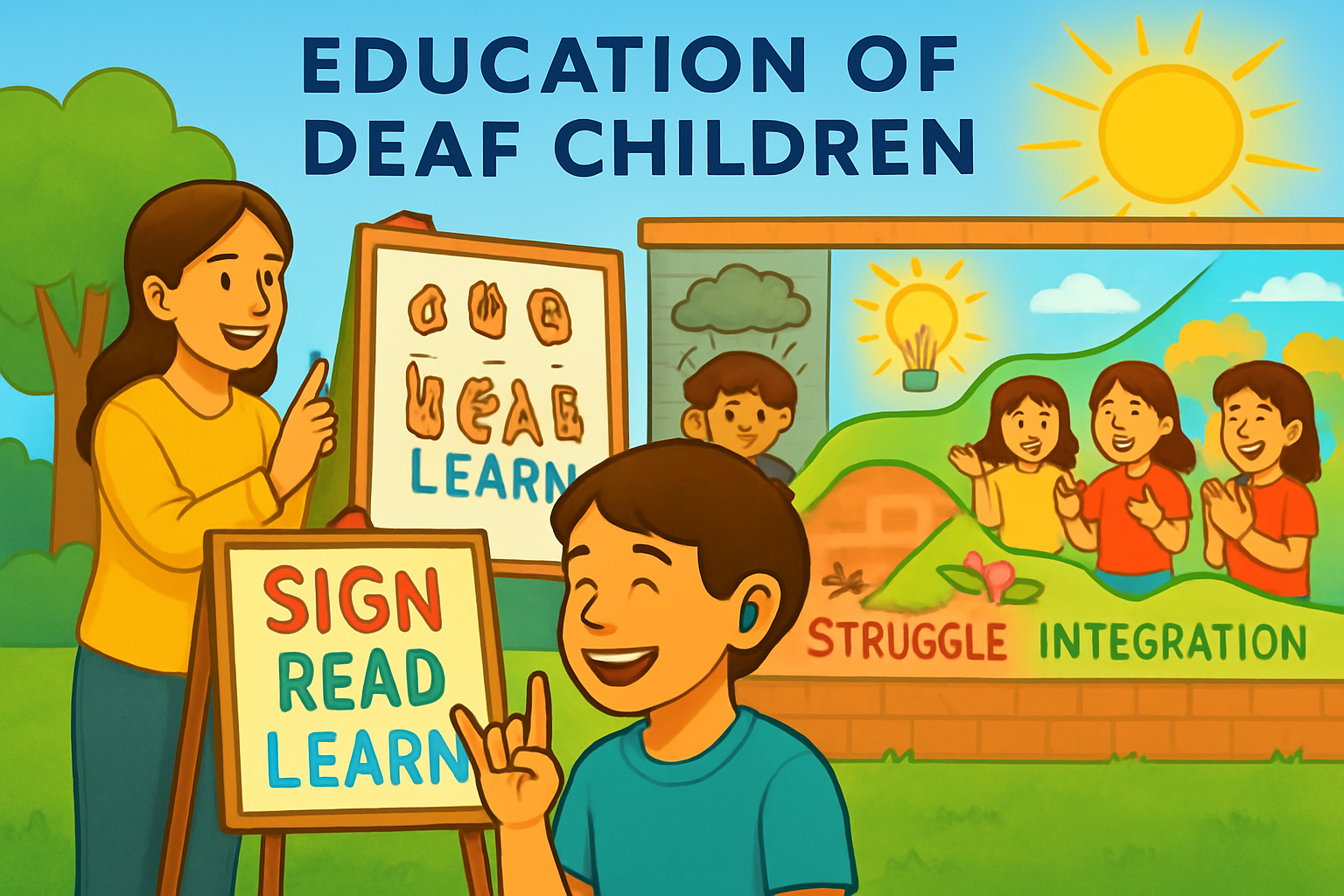
The history of deaf education is marked by struggles, setbacks, but also major victories. Thanks to the commitment of families, associations, and deaf communities themselves, many positive changes have taken place. The challenge remains immense, but the foundations are strong: to recognize the right to quality bilingual education, so that every deaf child can learn, thrive, and fully find their place in society.
ANPES: A Committed Voice Since 1994
Among the key players in this movement, the National Association of Parents of Deaf Children (ANPES), founded in 1994, works to amplify the voices of families. ANPES promotes a strong message: deaf children need education, not medical care. It advocates for full-time education in sign language within an adapted school environment, aiming to ensure that deaf children achieve an academic level equal to their peers. For more information about their work, visit www.anpes.fr.